
The Mission at CAMEL-AI.org: Finding the Scaling Laws of Agents
Building the Future of AGI through Multi-Agent Systems: A Journey with CAMEL-AI.org
The recent news about OpenAI forming a multi-agent team is exciting and promising for the field of AI. We are eagerly anticipating how they will approach multi-agent systems, as this is an area close to our hearts at 🐫 CAMEL-AI.org.
Our belief has always been simple yet profound: if AGI (Artificial General Intelligence) exists, it must be a multi-agent system. This conviction drives our mission to discover the scaling laws of agents.
Why Multi-Agent Systems?
Why do we focus on multi-agent systems? Here are a few key reasons:
- Intelligence Stems from Diversity: There is no single perfect principle. Intelligence is not monolithic but emerges from the interplay of diverse perspectives and capabilities. This idea aligns with Marvin Minsky’s Society of Mind.
- Divide and Conquer: Multi-agent systems inherently follow a "divide and conquer" approach, reducing the complexity of large problems by distributing tasks across multiple agents.
- Human Society Inductive Biases: Human society itself is a multi-agent system. By mimicking this structure, we leverage the natural inductive biases inherent in human problem-solving.
- Imperfect Information: Many real-world problems involve incomplete or imperfect information. These scenarios are distributed in nature, which are best addressed through multi-agent modeling.
- Scalability of LLM Inference: Multi-agent systems offer a more structured way to scale Large Language Model (LLM) inference by distributing workloads or search across agents, making them a natural fit for solving large-scale complex tasks.
Since March 2023, we’ve been building (to our knowledge) the first multi-agent framework based on ChatGPT at 🐫 CAMEL-AI.org. This framework is used for data synthesis, task automation, and world simulation—pushing the boundaries of what multi-agent systems can achieve.
A Challenging but Rewarding Journey
Our path hasn’t been easy. We’re navigating uncharted territory, facing uncertainty, and even challenging mainstream AI views. Convincing talented individuals to believe in and join this journey—where the future is not guaranteed—is perhaps the hardest part. Yet, over the past year and a half, we’ve built a strong, like-minded community and a team that shares this bold vision.
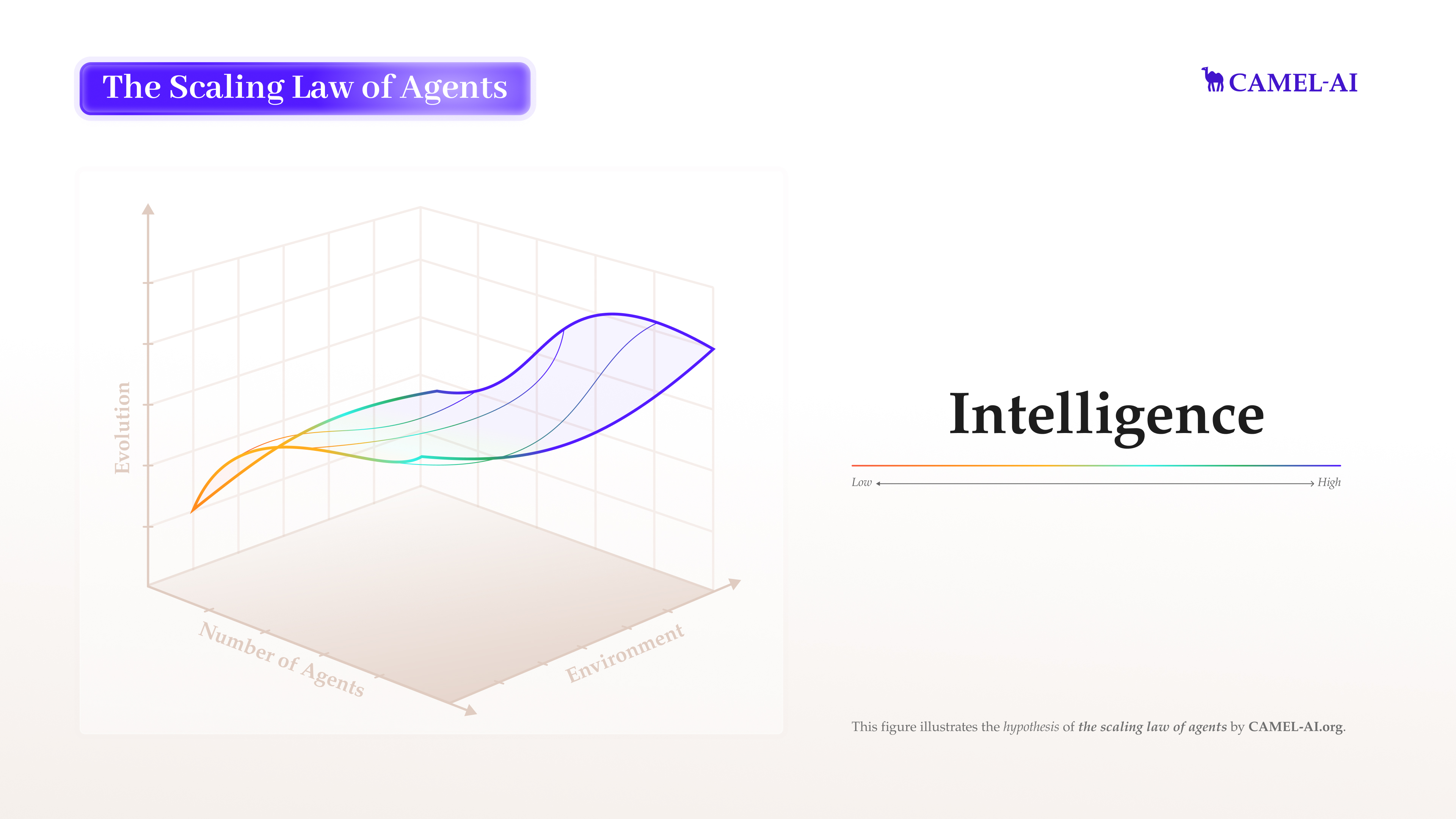
Our Hypothesis on the Scaling Laws of Agents
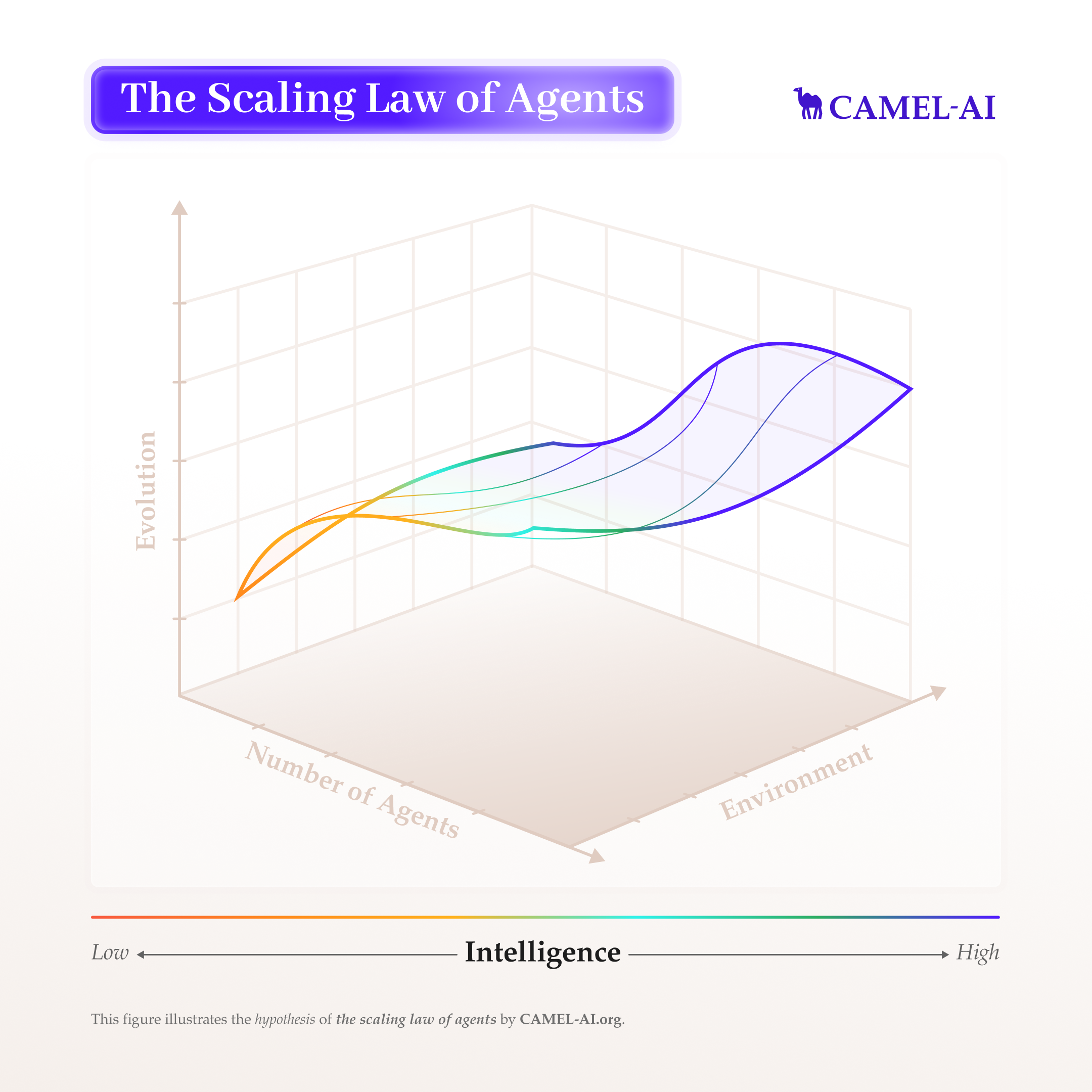
Scaling Law of Agents: Evolution vs. Agent Count and Environment
We’re particularly focused on three dimensions of the scaling laws of agents and here are some explorations we have done so far:
- Number of Agents: We developed CAMEL, a multi-agent framework, to model interactions and coordination among many agents.
- Environments: We created CRAB, a cross-environment agent benchmark, to test and challenge agents in varied settings.
- Evolution: Agents should evolve via environment interactions or constructing memories. We are building reinforcement learning environments and memory systems for agents, to create agents that can generalize across tasks, adapt to new challenges, and continuously improve through experience.
Although we are far from our ultimate goal, the journey excites us. We believe in the future of multi-agent systems, and we’re committed to building the infrastructure that will make them a reality—from frameworks, data, benchmarks, and models to applications and research.
Feel free to check out the work we’re doing at 🐫 CAMEL-AI.org, and let’s continue pushing the boundaries of what's possible in AI. If you share our vision, we welcome you to connect with us and help shape the future of multi-agent systems.
Recent Posts
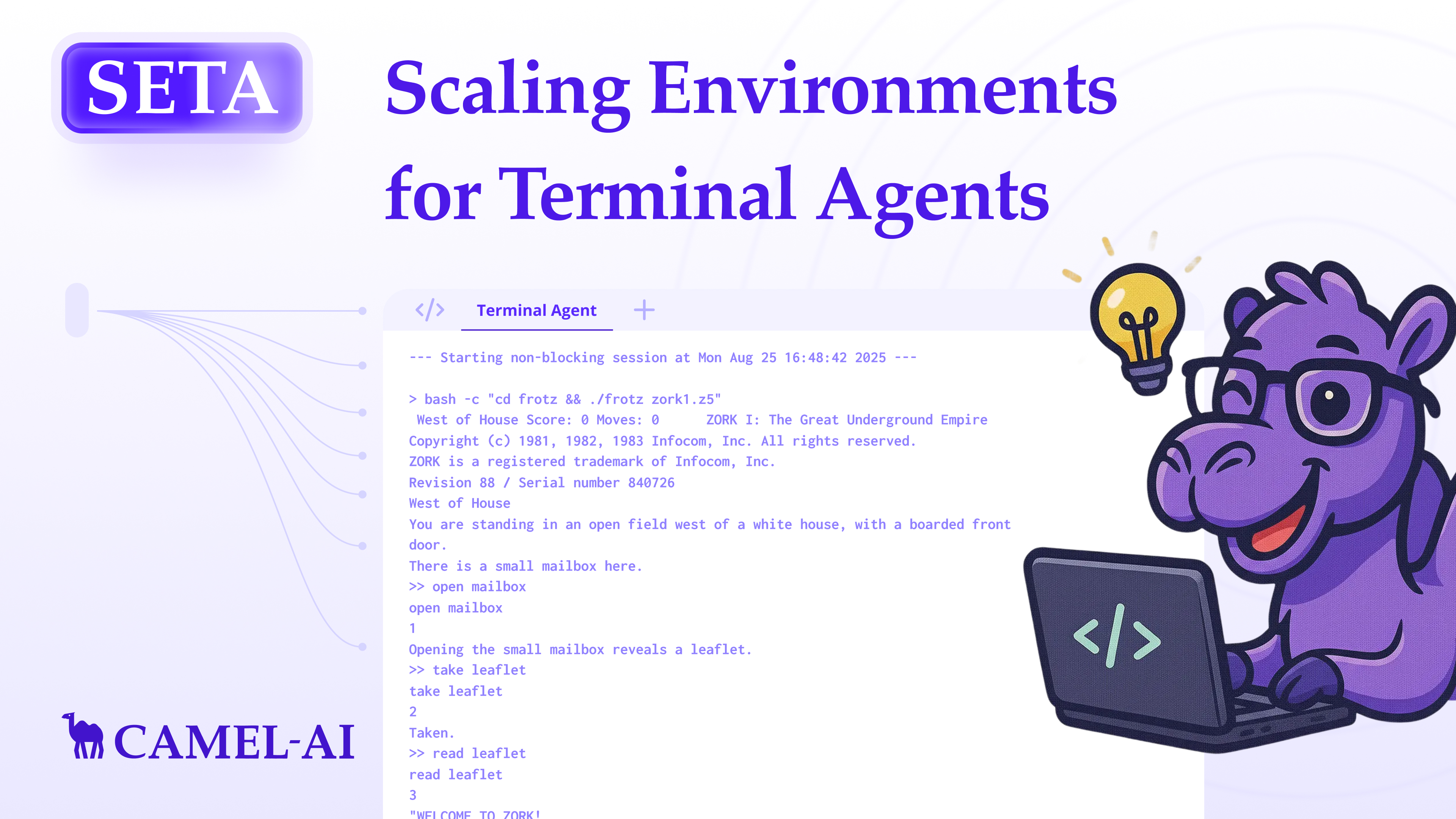
SETA: Scaling Environments for Terminal Agents
In SETA, we start with building robust toolkits to empower the agent’s planning and terminal capability, and achieved SOTA performance
Brainwash Your Agent: How We Keep The Memory Clean
How CAMEL Rebuilt Browser Automation: From Python to TypeScript for Reliable AI Agents
How CAMEL AI rebuilt browser automation with TypeScript for faster, smarter, and more reliable AI web interactions.